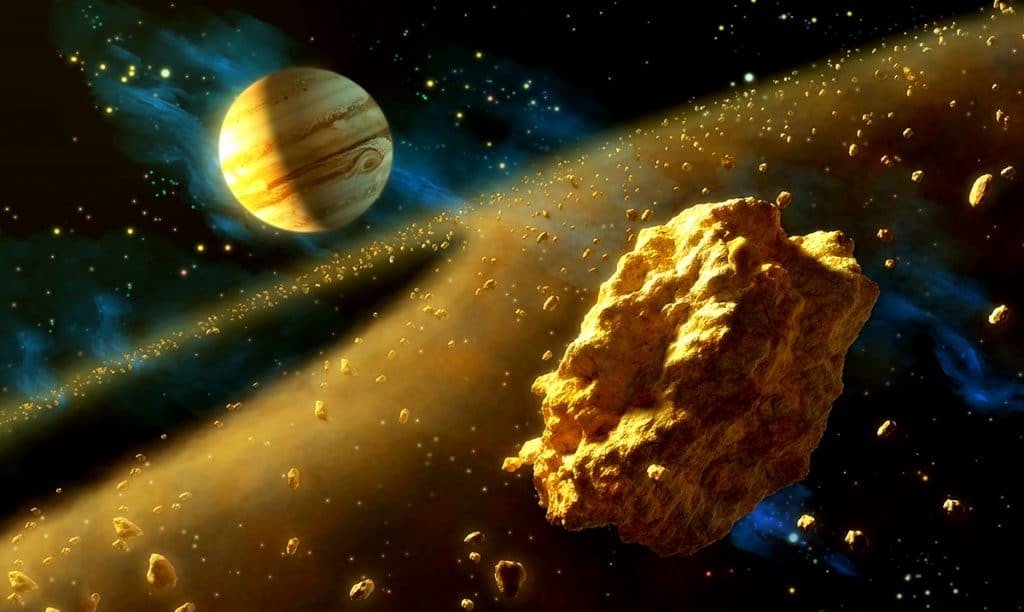
Gold and other precious metals are relatively rare on Earth because much of it sank into the planet’s core during its molten early history. But in space — especially in certain types of asteroids — these materials remain accessible near the surface.
Key Reasons for Interest:
- High-value metals : Some asteroids have more gold and platinum than entire Earth mines.
- Sustainability : Reduces pressure on Earth’s finite resources.
- Space economy : Could support long-term human presence in space.
- Economic potential : A single 50-meter-wide asteroid could contain billions of dollars worth of gold and platinum .
🌌 Types of Asteroids & Their Metal Content
There are three main categories of asteroids, based on their composition:
| Type | Composition | Gold/Precious Metal Potential |
|---|---|---|
| C-type (Carbonaceous) | Mostly carbon-rich; low metal content | Low |
| S-type (Silicaceous) | Stony with some metal | Moderate |
| M-type (Metallic) | Rich in iron, nickel, andprecious metals like gold and platinum | High |
🚀 How Would Asteroid Mining Work?
While full-scale operations are still in development, here’s a general outline of how mining gold from asteroids could work:
Step 1: Identify Target Asteroids
Use telescopes and satellites to find suitable candidates based on size, orbit, and mineral content.
Step 2: Launch Prospecting Missions
Send robotic probes to analyze the asteroid up close using spectrometers and drills.
Step 3: Extract Valuable Materials
Use robotic arms, lasers, or mining drones to extract metals.
Step 4: Process On-Site or Return to Earth
Either process materials in space (e.g., for use in orbit) or return them to Earth for refining and sale.

🔬 Promising Asteroids for Mining
Some of the most promising asteroids for mining include:
| Asteroid | Estimated Value (approx.) | Notes |
|---|---|---|
| 16 Psyche | Trillions of dollars | Believed to be a metallic core of a failed planet |
| 2011 UW-158 | $7 trillion in platinum alone | Contains large amounts of platinum-group metals |
| Ryugu | Unknown | Sample returned by Hayabusa2 mission showed rich mineral content |
| Bennu | Unknown | Studied closely by NASA’s OSIRIS-REx mission |
🏢 Companies Working on Asteroid Mining
Several private companies are investing heavily in research and development for asteroid mining:
| Company | Focus | Status |
|---|---|---|
| Planetary Resources (acquired by ConsenSys) | Asteroid prospecting tech | Pioneering early-stage research |
| Deep Space Industries (now part of Bradford Space) | Mining and processing systems | Developed prototype mining bots |
| NASA & ESA | Scientific missions | Studying asteroid composition for future mining |
| Moon Express | Lunar and asteroid mining | Developing space transport platforms |
| Blue Origin & SpaceX | Launch infrastructure | Enabling access to space for mining ventures |
🧪 Technologies Being Developed
To make asteroid mining a reality, researchers are developing cutting-edge tools and methods:
- Autonomous mining robots
- In-space manufacturing and refining
- AI-driven navigation and prospecting
- Solar-powered propulsion systems
- Onboard chemical processing units
These innovations will also support future lunar and Martian missions.
⚠️ Challenges Facing Asteroid Mining
Despite its promise, asteroid mining faces several major hurdles:
| Challenge | Description |
|---|---|
| Cost | Launching and operating in space is extremely expensive |
| Technology | Many required tools and processes are still experimental |
| Legal Framework | No clear international laws govern ownership of space resources |
| Return on Investment | Profitability uncertain without massive scale |
| Logistics | Transporting mined materials back to Earth or using them in space |
🌍 What Would Asteroid Mining Mean for Earth?
If successful, asteroid mining could:
- Reduce reliance on Earth-based mining
- Lower the cost of high-tech metals used in electronics and green energy
- Fuel space colonization by providing raw materials for building habitats
- Create new industries and jobs in aerospace and robotics
However, it could also disrupt current markets for gold and platinum, potentially causing price drops if supply increases dramatically.
Final Thoughts
The idea of mining gold from asteroids may sound like something out of a sci-fi novel — but it’s closer to reality than you might think.
With advances in space technology, growing interest from both governments and private companies, and increasing demand for rare metals, asteroid mining could one day become a cornerstone of the global economy .
While we’re not quite there yet, the journey has already begun — and the sky is no longer the limit.
FAQs
Q1: Can we mine gold from asteroids?
Yes, theoretically — many asteroids contain gold and other precious metals. However, large-scale mining is still in the research and development phase .
Q2: Is asteroid mining legal?
There is no comprehensive international law governing asteroid mining. The U.S. passed the Commercial Space Launch Competitiveness Act (2015) allowing companies to own mined resources, but international consensus is still forming.
Q3: Are there companies mining asteroids yet?
No company is currently mining asteroids, but several — including former Planetary Resources and Deep Space Industries — are developing the necessary robotic and AI technologies .
Q4: How much gold is in an asteroid?
Some asteroids, like 2011 UW-158 , may contain trillions of dollars worth of platinum-group metals , including gold. Exact amounts vary depending on the asteroid type.
Q5: Will asteroid mining affect gold prices?
Potentially yes — a sudden influx of gold from space could decrease its value unless demand rises proportionally or mining remains limited in scale.
